Hero SKU or Halo SKU?
The four stages every supplement brand moves through — and where most get stuck.
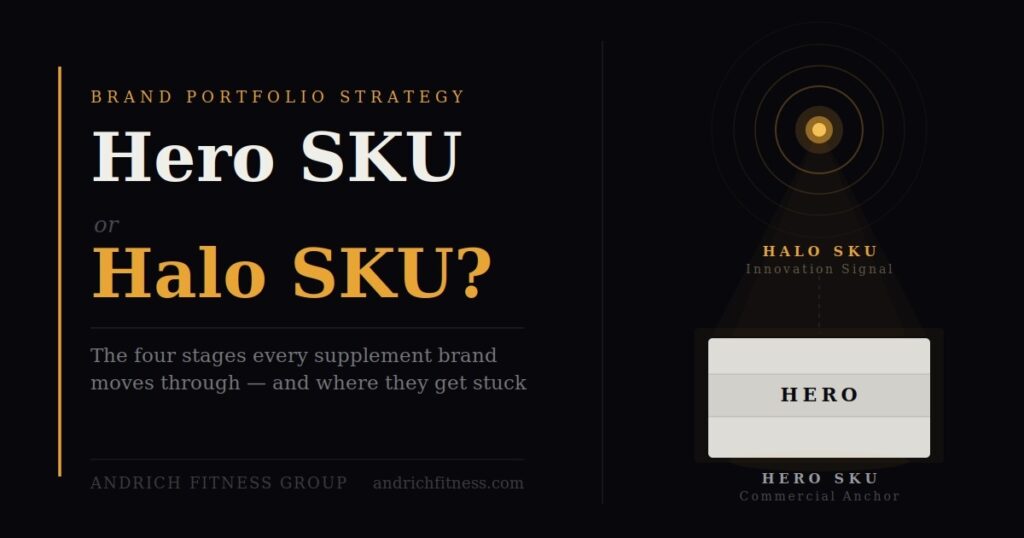
In 2008, Tesla launched the Roadster.
It was built on a Lotus Elise chassis. Limited production. Six-figure price point. Maybe 2,500 units over its entire lifetime. By any conventional volume metric, it was a commercial footnote.
But it proved something the entire automotive industry had decided was impossible: that an electric car could be fast, desirable, and worth wanting. It established a brand story before Tesla had the manufacturing capability to deliver that story at scale.
The Roadster wasn’t a volume play. It was a proof of concept — for the market, for investors, and for the consumers who would eventually buy a Model 3 because they believed in what Tesla stood for.
Then came the Model S. Tesla’s first fully proprietary platform. Their own body, their own powertrain. Premium, expensive, still relatively low volume — but the first product that proved Tesla could build a complete car without someone else’s bones underneath it.
Then came the Model 3. Accessible price point. Mass production. The product where volume and brand identity converged cleanly — where you could buy a Tesla without paying six figures and still feel like you were driving something that stood for something.
The Model 3 is the Hero. The Roadster was the Halo. And today, Tesla is stalling — not because the Hero stopped working, but because there’s no new Halo telling the market where the brand is going next. The new Roadster has been promised since 2017. Full Self Driving remains perpetually almost here. The innovation signal has gone quiet.
The same dynamic plays out in supplement brands every day. Just with less press coverage.
The Four Stages Every Brand Moves Through
Understanding the Hero/Halo framework starts with recognizing that every brand moves through four distinct stages — and that the strategic discipline required at each stage is different.
Stage 1 — Launch
One product. It carries every role simultaneously — commercial anchor, brand story, innovation signal, volume driver. Not by design. By necessity.
This is where Tesla was with the Roadster. This is where every supplement brand starts. The founder’s first product has to be everything at once because there’s nothing else in the portfolio yet.
The mistake brands make at this stage is believing that because one product is carrying both roles, that’s the natural state of things. It isn’t. It’s a launch condition. The portfolio needs to evolve past it.
Stage 2 — Separation
A second product enters the portfolio. This is where the Hero and Halo roles need to be deliberately assigned — and almost never are.
Most brands at Stage 2 launch the second product and see what happens. The market decides by default. The product that sells more becomes the focus. The product with the better story gets the media spend. These decisions aren’t coordinated — they’re reactive.
The brands that get Stage 2 right make an intentional call: which product is the commercial anchor, and which product is the innovation signal? They resource accordingly from day one rather than waiting for the data to force the conversation.
Stage 3 — Structure
The Hero is clearly defined. It’s the product where unit volume and brand representation converge — the best blend of commercial performance and brand identity. It leads the website, anchors the retail set, headlines the advertising, and opens every sales conversation.
The Halo is clearly defined. It’s the brand’s innovation signal — built for the early adopter, representing where the brand is going next rather than where it is today. Lower volume by design. Higher formulation ambition. It lives in the channels where brand credibility matters more than velocity.
This structure does three things: it concentrates commercial momentum behind the product that can carry it, it gives the brand a credible forward narrative, and it creates retail coherence — the buyer knows which product is the anchor and can shelf-set accordingly.
Stage 4 — Stall Risk
The Hero matures. Volume is strong. Distribution is broad. And somewhere along the way, the Halo disappears — or never gets built.
This is Tesla today. The Hero products are excellent. The Model 3 and Model Y are well-built, well-distributed, and competitively positioned. But without a new Halo — without an innovation signal telling the market what Tesla believes is possible next — the brand has lost its forward energy. Competitors who spent years catching up to the Model 3 have now caught up. And there’s no new proof of concept pulling the brand ahead of them.
In supplement brands, Stage 4 looks like this: a brand with a strong Hero SKU that has good velocity and solid repeat — but a portfolio that
Defining the Terms
The Hero SKU is the product where unit volume and brand representation converge most cleanly. It is not simply the highest-volume product in the portfolio — it is the product where commercial performance and brand identity align. The Hero should be able to represent the brand’s core differentiator without explanation. Someone who picks it up in a store or lands on the product page should immediately understand what the brand stands for.
The Hero leads everywhere: the website above-the-fold, the retail set anchor, the primary paid media creative, the featured product in the sales deck.
The Halo SKU is the brand’s innovation signal. It is built for the early adopter — the consumer who wants to be first, who values formulation ambition over price accessibility, and whose adoption gives the brand credibility in the channels that influence the broader market. The Halo represents where the brand is going next, not where it is today. Lower volume is not a failure. It is the appropriate commercial profile for a product doing the Halo’s job.
Both roles are necessary. The mistake is treating them as the same thing — or not knowing which role each product in your portfolio is actually playing.
What It Costs When Brands Get This Wrong
When brands mistake a Halo for a Hero — or ask one product to do both jobs at scale — four things happen, usually in this order:
They over-invest in marketing a product that cannot scale. Halo SKUs have higher formulation costs, niche appeal, and limited distribution potential by design. When retail marketing dollars, paid media, and sales team attention go behind a product with a ceiling, the brand is buying brand perception at the cost of commercial momentum.
They under-invest in the product actually driving the business. The Hero goes under-messaged and under-resourced while leadership focuses on the more interesting product. The product with the best velocity data, the widest appeal, and the clearest repeat pattern gets the leftover budget.
They create assortment confusion at retail. When the buyer can’t tell which product is the anchor and which is the premium extension, they make the shelf-set decision themselves. The result is poor placement, weak facings, and a brand story that lives in a footnote.
They lose the innovation signal without replacing it. When the Halo underperforms commercially and gets rationalized out of the assortment, the brand loses its forward narrative. The Hero is left carrying the full brand story at a stage when the market expects the brand to be moving forward — not just maintaining position.
The Hero-Halo Diagnostic: Five Questions
If you’re unsure which role a product in your portfolio is actually playing, run it through these five questions.
1. Who buys it?
A Hero SKU’s buyer profile is broad enough to drive volume. The consumer exists in significant numbers, makes repeat purchases, and fits the core brand positioning. A Halo SKU’s buyer is intentionally narrower — early adopters and enthusiast consumers who are valuable for brand credibility but not commercially scalable at the volume the business requires.
2. What is the repeat rate?
Hero SKUs drive repeat purchase. Strong initial sales with weak repeat is an acquisition story disguised as a product success — and it’s often a sign the Halo is being asked to perform the Hero’s commercial role.
3. What does velocity say?
At retail, velocity is units sold per store per week. The Hero should be at or above category benchmark. A product with strong brand credibility but weak velocity is functioning as a Halo — regardless of what leadership calls it.
4. Does it carry the positioning story without explanation?
The Hero should be self-evident. A product that requires context, education, or a longer sales conversation to justify its value to a first-time buyer is functioning as a Halo.
5. What happens to the brand if it underperforms?
Significant revenue disruption means it’s the Hero — or needs to be treated as one. Brand perception damage with manageable revenue impact means it’s functioning as a Halo.
The Halo’s Most Important Job: Protecting the Hero When the Brand Goes Mass
There is a dynamic that plays out at brands with category-leading Heroes that most operators don’t plan for in advance.
When a Hero SKU achieves enough velocity to move into FDM or mass retail channels, the core specialty audience — the consumers who found the brand early and identified with it deeply — often feels like the brand sold out. The product they championed is now on the shelf at a big-box chain. The exclusivity is gone.
The Halo is how you hold them.
A new Halo SKU launched into specialty before the Hero goes broad gives the core audience something to rally around that mass-market consumers don’t have access to yet. It tells them the brand hasn’t abandoned them. It keeps the brand’s innovation credibility intact in the channel that originally built it.
Launch the Halo approximately 90 days before the mass-channel Hero hits shelves. The narrative becomes proactive rather than defensive: We made our best seller more accessible so more people can experience what you already know. And here’s what we built next — just for you.
FAQ
Can a brand have two Hero SKUs?
Occasionally — but it’s rare and usually temporary. Two products splitting the Hero role means neither gets the full commercial weight of the brand behind it. Velocity suffers. Positioning fragments. The cleaner move is to designate one as the primary commercial anchor and treat the second as either a Halo or a secondary Hero with a clearly defined consumer segment of its own.
What if our highest-volume product doesn’t represent the brand well?
That’s a critical diagnostic signal. A high-volume product that doesn’t carry the brand story is a commercial asset without a strategic role — it funds the business but doesn’t build it. You either need to invest in repositioning it as the Hero, or acknowledge that your actual Hero hasn’t been built yet and treat it as a transitional volume driver while you develop the product that can do both jobs.
What if our Halo isn’t generating early adopter credibility?
If the Halo isn’t producing editorial coverage, elevating retail conversations, or protecting the specialty relationship, it isn’t functioning as a Halo — it’s a high-margin SKU with low velocity and no strategic return. Either invest in the credibility infrastructure to make it a real Halo, reposition it, or rationalize it out of the assortment.
How do we know when it’s time to build a new Halo?
When the brand’s innovation signal has gone quiet — when the market’s perception of your brand is defined entirely by what you’ve already built rather than where you’re going next. Tesla’s answer to this question is overdue by about seven years. Don’t let your brand get there.
Is Your Portfolio Structured — or Just Populated?
Most supplement brands don’t have a Hero and a Halo. They have a collection of products that accumulated over time without intentional role assignment. Some are working harder than they’re being resourced for. Some are being resourced beyond what their commercial role can justify.
A SKU Rationalization Audit identifies which products are earning their commercial roles, where portfolio complexity is creating drag, and how to restructure your assortment around the Hero that can lead your brand’s next growth phase — and the Halo that can point toward the one after that.