Let’s get one thing out of the way.
You are not going to out-spend Celsius, Ghost, or Nutrabolt on media. You are not going to out-shelf them at Target, GNC, or Walmart. You are not going to out-influencer them with a generic celebrity endorsement signed to a brand they don’t actually believe in.
If that’s your plan for winning the next five years in health and performance CPG, you don’t have a plan. You have a prayer.
The good news? The operators who are building the most durable audiences and the most loyal buyers are not winning on budget. They’re winning on context, operational discipline, and radical customer alignment: the exact three things a focused $5M–$50M brand can actually deploy.
In my 25 years operating inside brands like Quest Nutrition, Bang Energy, and JYM Supplement Science, I’ve had a front-row seat to a brutal reality: money doesn’t save a bad strategy. I’ve watched cash-starved startups become category leaders, and I’ve watched nine-figure war chests evaporate overnight. The dividing line is always the same. The brands that scale successfully solve a hyper-specific problem for a specific person. The ones that fail try to mean everything to everyone.
That’s what the best content operators in the world are teaching right now. But most health and fitness brands are extracting the wrong lessons. Here is what they are actually doing, where most founders get tripped up, and the precise blueprint for translating these frameworks to your brand.
The Thesis First
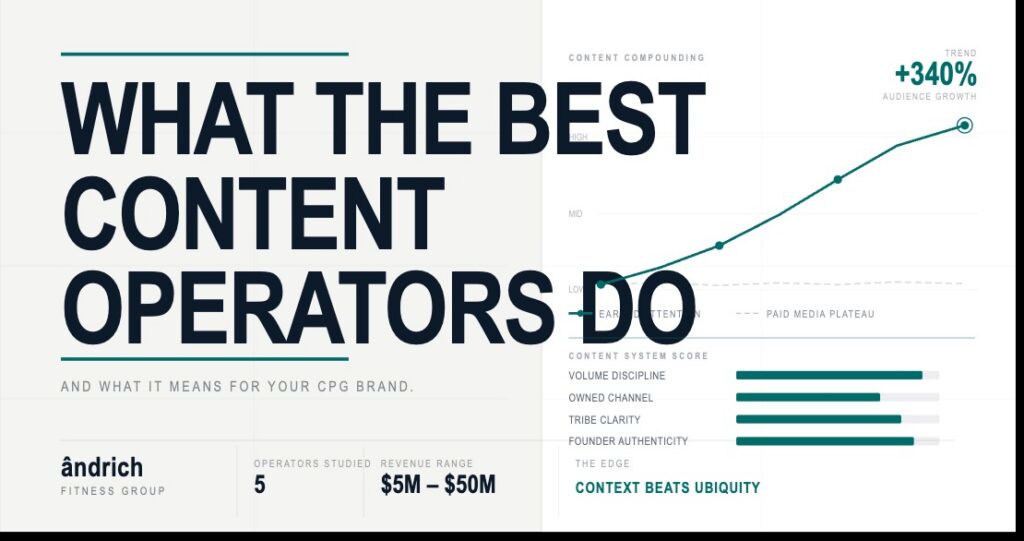
The operators studied here (Alex Hormozi, Seth Godin, Caleb Ralston, Dan Koe, and Dom Iacovone) are playing different games. But they share one foundational conviction: attention earned through value creation compounds faster and costs less than attention purchased.
For a mid-market health and fitness brand, that is not a philosophical preference. It is a commercial necessity.
You cannot buy your way to brand equity anymore. You can only earn it. The mechanism for earning it is content—not as a creative experiment, but as an operational system with the same rigor you’d apply to your supply chain or your gross margin.
A word of caution first. A dangerous pattern has emerged: founders over-indexing on their personal story and worldview as the primary content engine. A founder’s origin story can absolutely spark a brand from zero to $2M. But scaling from $5M to $50M requires a deliberate structural shift. The content must graduate from the founder’s story to the customer’s goals. Content is no longer just a marketing function at that stage. It becomes the infrastructure layer that proves your product helps the customer win their own daily battles.
1. Alex Hormozi: Volume Is an Operational Discipline, Not a Budget Burn
Alex Hormozi is one of the most-studied content operators of the decade. What most brands miss is that his framework is not really about content. It’s about operational rigor applied to distribution.
His core principle: you cannot create high-performing content from day one. You have to earn your way there through volume. He describes it as an accordion: expand by doing more, identify the top 10% that actually resonates, then expand again at a higher baseline. Volume is how you buy data.
His team scaled from 7 to 80 pieces of content per week without adding proportional hours by building a repurposing engine around a single long-form asset, usually a YouTube video or podcast episode, atomized into short-form clips, written posts, and email content across every platform. The content itself doesn’t change. The distribution architecture does.
The CPG Reality Check: Hormozi’s output machine runs on a paid internal media team that a $10M supplement brand cannot staff or sustain. Don’t try to match his volume. Match his discipline.
- The Operator Translation: Shoot one high-value expert asset per week focused entirely on solving a core customer problem: a deep-dive on recovery, a formulation breakdown, a training protocol. Atomize that single asset into three short-form video concepts, one educational text post, and one email broadcast. You are not chasing virality. You are generating the data that tells you what your customer actually cares about.
2. Seth Godin: Win Your Tribe, Not the Masses
Seth Godin has been saying the same thing for 25 years, and most brands still don’t believe him.
His Purple Cow principle—that being remarkable is the only viable strategy in a crowded market—is not a creativity prompt. It is a positioning imperative. In a category flooded with interchangeable “clean label” pre-workouts and “transparent formula” proteins, the brands that look the most alike disappear first.
His permission marketing principle is equally actionable: consumers today are not interruption-tolerant. The brands that win build audiences who actively want to hear from them, because they earned that right by delivering value before asking for the transaction.
But his most underutilized concept for mid-market brands is the smallest viable market. Instead of asking “who is the broadest possible audience for this product?” Godin asks: “What is the smallest group of people for whom this product is the only logical choice?” That first question leads every supplement brand to slap “for serious athletes” on their tub and wonder why nothing sticks.
The brands that answer Godin’s question precisely and serve that group obsessively develop word-of-mouth velocity, repeat purchase rates, and brand loyalty that no media budget can manufacture.
- The Operator Translation: Before you write another line of ad copy, identify your specific tribe. Are you the ultimate performance fuel for competitive CrossFitters, or the clean-ingredient choice for the health-conscious working parent? Build content that serves that avatar’s specific goals and daily obstacles. Let the mega-brands spend millions fighting over the generic “anyone who works out” demographic.
3. Caleb Ralston: Infrastructure Before Audience
Caleb Ralston is the operational architect behind the content engines at Alex Hormozi and Gary Vaynerchuk. He is not a personality. He is an operator. And his most important insight is the one founders most consistently skip: most brands try to build an audience before they build the infrastructure to sustain one.
Ralston’s framework starts with locking down the foundation:
- What is the desired commercial outcome?
- Who is the exact audience?
- What specific association do you want to own in that person’s mind?
Until those are answered, content production is expensive noise.
From there, his entire approach is data-driven. He is explicit that quality is subjective, meaning subjective creative decisions generate internal conflict and wasted resources. The only quality metric that matters is performance data. What holds attention? What drives comments? What converts to a subscriber, a click, a purchase?
His team-building philosophy is equally practical: you don’t need a full content department. You need to identify your bottleneck. Is it ideation, filming, editing, or distribution? Solve the specific constraint first. Use contractors to validate the concept, bring on full-time support only when the system has proven itself.
One of the cleaner principles in his framework, which he credits to Gary Vee: “Don’t build what I built. Build what they need.” There is no universal content org chart. The right system is the one engineered around the founder’s actual medium, audience, and commercial objective.
- The Operator Translation: Answer Ralston’s foundational questions before your next content push. Then find your real bottleneck. It is almost never ideas, and almost always production capacity or distribution strategy. Solve the constraint first. Build the machine around what actually works.
4. Dan Koe: The Founder’s Worldview Has a Ceiling
Dan Koe’s framework champions the idea that your unique perspective, earned through specific lived experience, creates a “category of one” where no direct comparison exists. In a world drowning in AI-generated content, that principle is increasingly valuable.
And in the CPG space, it holds up, with one critical nuance that most founders miss.
Take Quest Nutrition. The back of every Quest bar tray carried a simple manifesto about not being normal, about never quitting, and treating life as a personal quest. That founder worldview, driven by founders Ron Penna, Shannan Penna, and Tom Bilyeu, gave the brand a soul. It attracted early believers. And yes, Tom’s Inside Quest interview series later amplified that mission to a broader audience.
But Quest didn’t break $50M on worldview. It blew past $50M on the “Cheat Clean” narrative: the practical, customer-focused idea that you could eat a protein bar that tasted like a candy bar and still hit your macros.
Fans weren’t just buying a philosophy. They were cooking Quest bar “cookies” and posting the recipes. They were solving a real daily problem: eating well without eating miserably. Quest gave them both the product and the language to do it.
The worldview created the community. The customer utility drove the volume.
- The Operator Translation: Use the founder’s voice to establish authority and trust, but keep the content pointed outward. Your “category of one” positioning isn’t a founder diary. It’s your brand’s unique framework for helping the customer win. Give them the language, the recipes, the protocols, the workouts—the tools that make your product relevant to their daily life. The customer is the hero of the story. Your product is what helps them win it.
5. Dom Iacovone / RAW Nutrition: The Mid-Market Jordan-Nike Play
Dom Iacovone built RAW Nutrition into a $230M business without spending a dollar on paid media advertising.
Let that land.
While that is likely an exaggeration, the reality is, they spent way less than what their revenue line tells us.
RAW scaled almost entirely on word of mouth and social content, including what Iacovone describes as “funny social media clips,” and by executing a mid-market version of the classic Nike/Michael Jordan deal. They partnered with Chris Bumstead at a time when he was ascending, but not yet six-time Mr. Olympia. Instead of paying him a standard influencer fee for a transactional endorsement, they gave him equity and made him a co-owner.
A move that later could be described as… Generous & Genius.
That single structural decision changed the entire content architecture. Bumstead’s audience didn’t see a paid ad. They saw an elite athlete building his own brand. The alignment was credible because the stake was real. It created a self-sustaining source of earned media that drove retail velocity before RAW ever asked for nationwide shelf space.
When they did, they had the DTC numbers to negotiate from strength. RAW was named Brand of the Year at both GNC and Vitamin Shoppe.
The lesson is not “go find a Mr. Olympia champion.” The lesson is: stop spending your budget on transactional micro-influencers who post a generic product selfie and disappear. Find the coaches, trainers, and athletes in your specific niche whose values genuinely align with your brand’s mission. Structure deals that create real skin in the game: custom product lines, aggressive revenue shares, or performance-based equity stakes. Turn your ambassadors into co-owners. Their content stops being an obligation and becomes an obsession.
- The Operator Translation: Build ingredient transparency into the content. Be present as a founder, not managed behind a PR filter. Build community and DTC velocity before you chase the retail conversation. And when you find someone who genuinely believes in what you’re building, find a way to make them part of it.
The Strategic Blueprint: Five Rules for $5M–$50M Brands
These are not tactics. This is a sequenced system architecture.
Phase 1: Position and Anchor
- Rule 1: Define the tribe, not the worldview. Answer Godin’s question first: who is the smallest group of people for whom your product is the only logical choice? Build every piece of content to address their specific goals, obstacles, and daily problems. The founder’s story is a credibility pillar, not the main event.
- Rule 2: Pick one primary discovery engine and master it. YouTube for formulation science, education, and search authority. Instagram or TikTok for visual, lifestyle-driven, and transformational content. Master one platform before diversifying. You need volume on a single channel before you have signal worth acting on.
Phase 2: Systemize and Test
- Rule 3: Build the engine around your bottleneck. Apply Ralston’s discipline. If content production is the constraint, hire an agile editor. If ideation is the constraint, mine your customer support inbox and your reviews. The questions your buyers are already asking are your content calendar. Test three distinct creative concepts weekly to find what actually converts.
- Rule 4: Move from endorsements to equity. Execute the RAW Nutrition model at the scale that fits your current budget. Identify one to three figures in your niche who command genuine trust with your exact buyer. Give them real upside. Let them distribute content they actually believe in.
Phase 3: Capture and Capitalize
- Rule 5: Own the channel before you need it. Drive your audience off rented social platforms and into owned email and SMS lists. Deliver high-utility content weekly: training protocols, recipes, recovery breakdowns that integrate your product naturally into the customer’s routine. A list of 5,000 engaged subscribers who bought from you is worth more to your business than 50,000 social followers you don’t own and can lose overnight. That owned channel is your most defensible asset. Build it now.
The Hard Truth
Most health and performance brands in the $5M–$50M range are not losing because their products are inferior. They are losing because they are trying to play a giant’s game with a mid-market budget.
The big brands win on ubiquity. They spend to ensure they are everywhere, all the time. You cannot out-ubiquity them. You should not try.
What you can do, and what every operator studied here is demonstrating in real time, is win on context. Be the brand that means something specific to a defined group of people. Show up with a point of view. Build a content system designed not just to generate impressions, but to make your customer more successful. Treat your audience like a community of owners and they will behave like one.
Context beats ubiquity. Always has.
There is a 2006 book called Naked Conversations that most marketers have never read and most founders have never heard of. Robert Scoble and Shel Israel argued that the companies willing to drop the corporate filter, to speak directly and authentically without the PR layer, would build something no ad budget could manufacture: trust at scale.
Nobody believed them then, either.
What the best content operators are demonstrating is that the thesis was right. It was just early. The platform changed. The mechanism changed. The underlying truth didn’t.
Drop the filter. Show the work. Mean something specific to someone specific.
That’s what “naked” looks like today. We just call it building an audience now.
Vince Andrich is the founder of Andrich Fitness Group and a 25+ year operator in health and performance CPG, with senior leadership roles at Quest Nutrition, Bang Energy, JYM Supplement Science, GNC, EAS, and MET-Rx. He works with founders and CEOs of $5M–$100M brands on revenue strategy, positioning, and portfolio architecture.