Influencer marketing looks cheaper on a spreadsheet. But when you’re selling a premium health or performance product to a high-intent buyer, the metric that matters isn’t cost per impression. It’s trust per dollar.
Vince Andrich | Founder, Andrich Fitness Group | June 2026
KEY STATISTICS
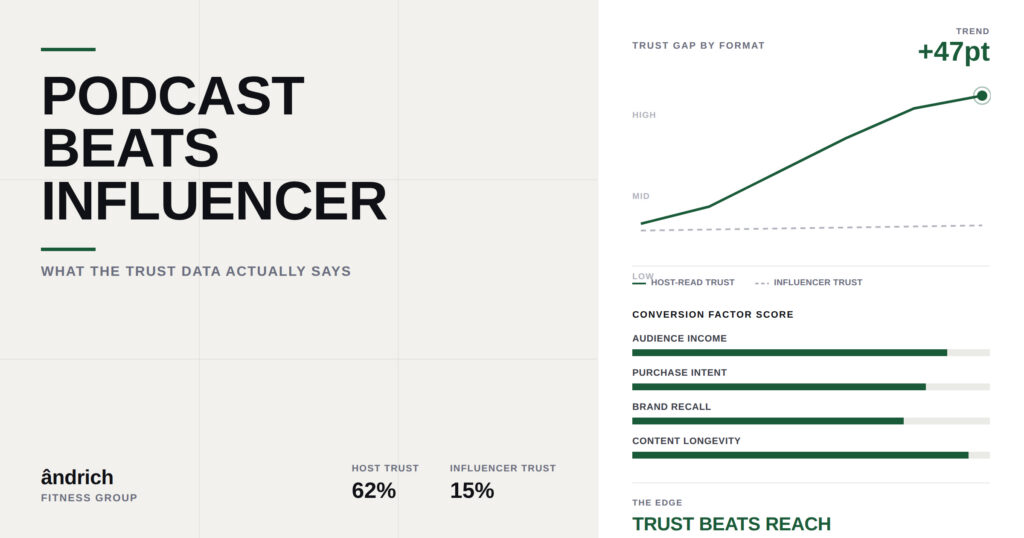
62% of podcast listeners trust an ad read by their favorite host
15% of consumers trust a social media influencer recommendation
3× higher brand recall for podcast ads vs. traditional digital audio (Claritas, 2025)
THE SETUP
Every brand budget conversation eventually comes back to the same question
Podcast or influencer? The influencer pitch is seductive: massive follower counts, visual content, lower CPMs, easy to measure clicks and swipes. On paper it looks efficient.
But efficiency and effectiveness are different things. And in the health and performance category — where the buying decision is high-consideration, the product is personal, and the audience has been burned by overhyped claims — efficiency without trust is just noise.
Here’s what the data actually shows, and why the brands winning in this category right now are making a different bet.
THE TRUST GAP
A 47-point difference that doesn’t show up in your CPM report
The 2025 SuperListeners Study found that 62% of podcast listeners trust an ad read by their favorite host. The same research found that only 15% of consumers trust a social media influencer recommendation.
That 47-point gap is the most important number in media buying that most brand managers never see — because it doesn’t appear on a standard media plan.
When a host who has spent years building credibility with their audience tells that audience about your product, it’s not an ad. It’s a recommendation from someone they trust more than most people in their real lives.
— Vince Andrich, Andrich Fitness Group
The mechanism matters. A social media influencer’s credibility is aspirational — you want to be like them. A podcast host’s credibility is earned through time and intellectual depth. Their audience has spent hundreds of hours with them. That relationship is fundamentally different from a follower count.
THE ATTENTION GAP
Your influencer ad got 3 seconds. Your podcast ad got 8 minutes.
The average social media video ad is skipped or scrolled past in under 3 seconds. The average podcast episode runs 45 to 90 minutes, and a host-read ad lives inside that conversation — not before it, not after it, but woven into content the listener chose to spend an hour with.
That’s not a small difference. That’s a different category of attention entirely.
WHY THIS MATTERS FOR HEALTH & PERFORMANCE BRANDS
The health and performance buyer is not an impulse purchaser. They research. They compare. They read ingredient labels. They trust experts. The format that reaches them while they are actively engaged in learning — not passively scrolling — is the format that moves them. Podcast advertising is that format.
THE LONGEVITY ARGUMENT
You buy it once. It keeps working.
This is the most underappreciated advantage of host-read baked-in podcast advertising, and the one that makes it structurally different from almost every other paid media format.
A baked-in ad is permanent. It lives in that episode. Every time someone downloads that episode — today, six months from now, two years from now — they hear the host’s recommendation. The back catalog effect is real. Shows get recommended. New listeners binge from the beginning. A well-placed ad keeps converting long after the campaign officially ends.
Compare that to any social media campaign: the moment you stop spending, reach drops to zero. Influencer posts decay within 48 hours. Paid social evaporates the second the budget does.
A well-placed podcast ad is less like a paid placement and more like a piece of owned media. The economics compound in a way no social campaign can match.
— Vince Andrich, Andrich Fitness Group
THE BOTTOM LINE
The right metric changes everything
If you’re optimizing for cost per thousand impressions, social influencer marketing will often win on paper. It’s a cheaper way to reach a lot of people quickly.
But if you’re selling a premium health or performance product — a product that requires trust, credibility, and a buyer who has already done their research — the metric that actually predicts revenue is purchase intent per dollar. Not impressions per dollar.
On that metric, host-read podcast advertising in the health and performance category is not close. The audience is more educated, more loyal, more trusting of the host’s recommendation, and more likely to act on it.
The brands that understand this distinction are the ones quietly building category ownership while their competitors chase follower counts.
Vince Andrich | Andrich Fitness Group | Vince@andrichfitness.com
