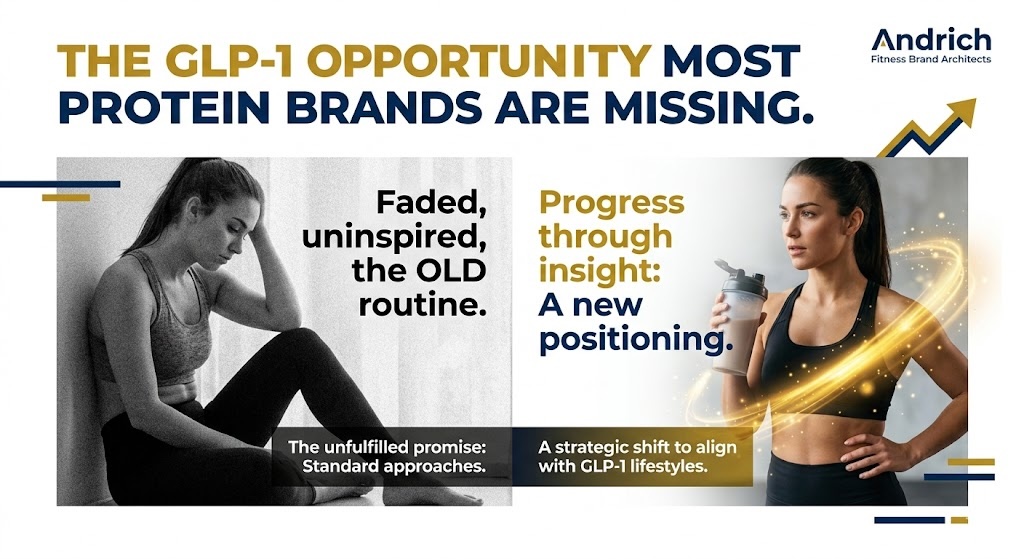
GLP-1 drugs are reshaping how Americans eat — and most protein brands are still responding with the wrong message.
There is a brand positioning argument available to protein companies and protein-fortified food brands right now that most have not made. Not because the insight is complicated. Because they’re too focused on the drug.
GLP-1 receptor agonists have reshaped how tens of millions of consumers relate to food. Appetite is suppressed. The hedonic drive to eat, the dopamine reward loop that makes food feel satisfying and worth seeking, is quieted. Users eat less, want less, and increasingly struggle to find pleasure in eating at all.
Most supplement and food brands responding to this shift are making the same mistake: they’re trying to become a GLP-1 product. They’re chasing the drug label. And in doing so, they’re missing the actual opportunity, which is not about the drug at all.
The opportunity is to become the lifestyle choice for the person the consumer is becoming.
The Drug Is Temporary. The New Identity Isn’t.
People on GLP-1 medications aren’t just losing weight. They’re undergoing an identity shift. They eat differently. They move differently. Their relationship with food, what they reach for, what feels satisfying, what they think of themselves as eating, changes. Many describe it in exactly those terms: becoming a different person.
That window of identity formation is the most important marketing moment available to protein brands right now. Not because you should market to GLP-1 users. But because you should market to the person they are in the process of becoming.
The consumer who is rebuilding their relationship with food during a GLP-1 suppression phase is neurologically more open to forming new food habits than at almost any other point in their adult life. The old habits are quieted. The hedonic pulls that drove their previous eating patterns are dampened. They are, in a very real sense, building a new baseline.
A protein brand that shows up in that window, with a product that tastes genuinely good, supports muscle preservation, and fits into the body and life they’re building, isn’t just selling a supplement. It’s being woven into a new identity.
The Two Arguments Protein Brands Should Be Making
The functional argument: lean muscle preservation.
GLP-1 users eating in a significant caloric deficit are losing muscle alongside fat. Research shows many struggle to consume even 60-80 grams of protein per day, not because they don’t want to, but because appetite suppression makes food intake genuinely difficult. Protein supplementation isn’t a convenience play for these consumers. It’s a clinical necessity for maintaining the body composition outcomes they’re seeking.
Lead with that. “Protect your muscle while your body transforms” is a completely different message than “great taste, 25g per serving.” One is functional wallpaper. The other is a commercial argument with real clinical stakes.
The behavioral argument: habit formation and long-term identity.
This is the one most brands miss. When the hedonic food drive is suppressed, a protein product that delivers genuine sensory satisfaction does something no pill or injection can do: it creates a new conditioned association between satisfaction and a better food choice.
Taste matters more during GLP-1 use, not less, and for exactly this reason. A shake or protein food the user actually looks forward to becomes the new source of food reward during a period when old reward sources are muted. Over months of use, that becomes the habit. That becomes the baseline. That becomes what the consumer reaches for when hunger and appetite return.
When the drug phases out, and for most users it eventually does, whether by choice, cost, or medical guidance, the appetite returns. The reward-seeking behavior returns. For consumers who built no new habits during the suppression window, the data on rebound weight gain is clear: many revert. But for consumers who spent months finding genuine satisfaction in a protein-forward product, that habit is already formed. They don’t revert 100% to hyperpalatable junk because they have an established alternative that satisfies them.
On the Drug. Off the Drug. You’re Still the Right Choice.
This is where the positioning gets powerful. And durable.
A protein brand or protein-fortified food company that frames its messaging around GLP-1 support has a product with a trend-dependent shelf life. When the drug landscape evolves, with new formulations, new competitors, new clinical guidance, or a shift in public sentiment, the “GLP-1 product” label becomes a liability. Future Market Insights GLP-1 diet food market report
But a brand positioned as the protein choice for the person you’re becoming? That positioning doesn’t expire. It works for the GLP-1 user managing a transformation today. It works for the post-GLP-1 user maintaining their results. It works for the person who’s never touched the drug but is in a body composition or lifestyle change arc of their own. It works for the athlete. The aging adult prioritizing muscle health. The health-conscious consumer who eats differently now than they did five years ago.
On the drug. Off the drug. Before the drug. Never on the drug. The message holds.
The drug is temporary. The body isn’t. Your product should be the constant.
What This Means for Your Brand Messaging
If you’re leading a protein brand or protein-fortified food company, here’s the strategic brief:
Stop marketing to what the consumer is doing (taking a GLP-1 drug). Start marketing to who they are becoming, someone who eats differently now, protects their muscle, and has rebuilt their relationship with food around better choices.
Your product is the physical expression of that new identity. Lead with lean muscle preservation as the functional outcome. Build taste and sensory satisfaction as the behavioral retention story. Frame both inside an identity-level message: this is the protein choice for the new you. On the drug, off the drug, you’re the lifestyle.
That’s not a GLP-1 campaign. That’s a brand position. And it’s one that will outlast every drug trend that follows this one.
Andrich Fitness works with supplement brands, performance nutrition companies, and functional food operators on product positioning, go-to-market strategy, and commercial messaging. If you’re ready to build a brand position that outlasts the trend, that conversation starts here.