
The Messaging Hierarchy Every Supplement Brand Needs — and Most Don’t Have
If your brand can’t answer three questions in under 60 seconds — who this is for, why it’s different, and why it matters right now — your messaging isn’t a hierarchy. It’s a pile.
Most supplement brands confuse messaging with marketing. They write copy. They produce content. They build decks. And still, nothing converts the way it should. The website underperforms. The Amazon listing bleeds margin to discounts. The retail buyer asks a question the brand team can’t answer cleanly.
The problem isn’t execution. It’s architecture. Specifically, the absence of a messaging hierarchy. Here’s what that costs you — and what it looks like when you get it right.
What a Messaging Hierarchy Actually Is
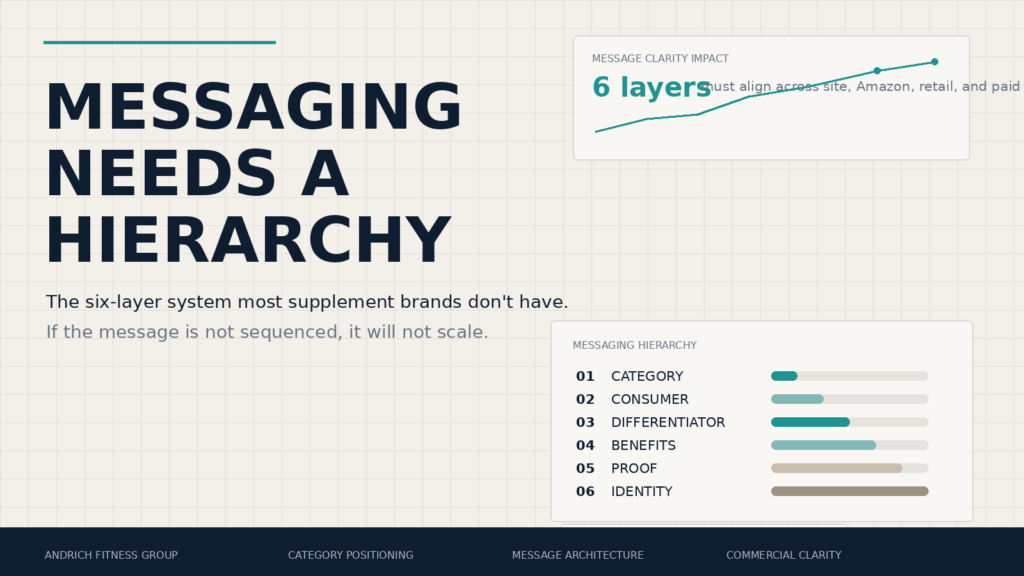
A messaging hierarchy is not a tagline. It’s not a brand voice guide. It’s the logical framework that organizes every claim your brand makes — from your highest-level positioning down to the specific benefit statements on your product label.
It answers, in sequence:
- What category does this brand play in?
- Who is the specific target consumer, and what is their primary job-to-be-done?
- What is the brand’s core differentiator — the one thing competitors can’t honestly claim?
- What are the functional benefits that support that differentiator?
- What are the ingredient or formulation proof points that make those benefits credible?
- What is the emotional or identity payoff for the consumer?
When these six layers are aligned — and consistent across every channel — your brand is positioned to convert. When they’re missing or misaligned, your brand looks like every other product on the shelf.
Why Most Supplement Brands Don’t Have One
It’s not because leadership isn’t smart. It’s because most brands build messaging from the inside out instead of the outside in.
The formulator describes the ingredients. The marketing team writes around those descriptions. The agency adds creative language. The result is messaging that sounds impressive internally and flat externally.
The other common failure is channel fragmentation. The DTC site says one thing. The Amazon listing says something slightly different. The retail sell sheet emphasizes a third angle. The paid social ads pick up yet another claim. None of it is coherent. None of it builds on itself.
To the consumer, the brand feels inconsistent. To the retail buyer, it feels unfocused. To the investor, it looks like a brand that hasn’t figured out what it is.
The Four Signs Your Messaging Hierarchy Is Broken
Sign 1: Your headline could describe any brand in your category.
If your positioning line is “Premium quality. Superior results,” you don’t have positioning. You have words. Every competitor in your space could say the same thing with a straight face — and most of them do.
The test is simple: swap your brand name out and drop a competitor’s name in. If the headline still works, it isn’t doing its job. A real positioning statement is specific enough that it couldn’t belong to anyone else. It names a problem, a person, or a standard that your brand owns — not a feeling that every brand in the category is already claiming.
Sign 2: Your team can’t describe your target consumer without using demographics.
“Our customer is 25–45, active, health-conscious.” That’s not a consumer profile. That’s a census segment. Half the brands in your category would write the same sentence.
A real messaging hierarchy is built around a specific person with a specific job-to-be-done. The brands that have gotten this most right — across four decades and wildly different formulation stories — all answered the same consumer question: how do I keep my nutrition on track when real life keeps getting in the way?
Huel is executing this playbook right now for a modern audience. The positioning isn’t “great-tasting protein.” It’s nutritionally complete food — precisely formulated meals with the right macros, micronutrients, and ingredient transparency for people who want to eat well consistently without the complexity of preparing whole food every time. The consumer isn’t defined by age or income. They’re defined by a commitment to their nutrition and a need for a more executable solution.
Original Muscle Milk ran the same play with a different formulation story. The original formula — high protein, moderate carb, lean lipids, and an amino acid system designed to support the body’s natural creatine synthesis — wasn’t positioned as a protein powder. It was positioned as a meal, built around what human mother’s milk — one of nature’s most anabolic foods — actually looks like nutritionally. That’s why it became the de facto meal for serious athletes and active people. Different science, same consumer truth.
EAS took that consumer truth and turned it into a platform. Myoplex launched as a single hero SKU — a high-performance meal replacement built for athletes who needed precision nutrition, not just protein. But EAS recognized that the core problem — how do I keep my diet on track — existed across a wide spectrum of consumers, from elite competitors to casual fitness-minded people. So they segmented the hero into a full product platform: Myoplex Deluxe, HP, Lite, and Low Carb. Each variant answered the same fundamental question for a different type of person at a different intensity level. The result was a brand that captured the entire category it helped define, and became the undisputed number one sports nutrition brand worldwide from 1997 to 2003.
MET-Rx created the category that made all of it possible. In the early 1990s, the original MET-Rx meal replacement — high protein, moderate carbohydrate, scientifically formulated for body recomposition — was built around a single, motivating insight: people who trained hard weren’t failing in the gym. They were failing in the kitchen, on the road, and in the office. Convenience kept beating intention. MET-Rx was the first precise answer to that problem at scale. Later, the brand followed the segmentation playbook with Anabolic Drive — a sub-brand targeting high-level athletes using carb cycling protocols for maximum muscle gain and fat loss. Same consumer problem, expressed at the most sophisticated end of the spectrum.
Four brands. Four decades. Four different formulation stories. One consumer truth that never changed. When your consumer profile is a demographic, you have a category. When it’s a job-to-be-done, you have a positioning — and potentially a 30-year runway.
Sign 3: Your claims list is longer than your elevator pitch is clear.
When brands list 15 benefits on a product page, they’re not communicating. They’re dumping. And the reason it happens is almost always the same: no one inside the organization was forced to choose.
A working messaging hierarchy forces the choice. It sequences benefits in priority order — the claim with the highest purchase intent impact first, not the one the formulator is most proud of. Everything else either supports that lead claim or gets cut. Clarity converts. Completeness confuses.
Sign 4: You get different answers depending on who on your team you ask.
If the VP of Marketing, the VP of Sales, and the brand manager each describe the brand differently, you don’t have a hierarchy — you have a fragmented internal narrative leaking into every customer touchpoint.
This one is more common than most leadership teams want to admit. It shows up as slight variations in language across channels, different emphasis in retail conversations versus DTC copy, and paid media creative that drifts further from the core positioning every quarter. Each individual decision seems small. Cumulatively, the brand becomes harder to understand — and harder to buy.
The Five Layers of a Working Messaging Hierarchy
Layer 1: Category Positioning
The foundational claim about what space your brand occupies. Specific enough to differentiate, broad enough to scale. “Performance recovery for strength athletes” is more useful than “sports nutrition” and more scalable than “post-workout powder for powerlifters.”
Layer 2: Consumer Identity
Your best messaging isn’t about your product. It’s about the person your consumer is becoming or wants to be. Define them not by age and income, but by aspiration, behavior, and pain point. This is the layer most brands skip — and it’s where most of the conversion leverage lives.
Layer 3: Core Differentiator
The one claim that is both true and unique to your brand. Not “clinically dosed” — half your competitors claim that. Not “clean label” — table stakes. The real differentiator lives at the intersection of what your consumer cares about most and what your brand can deliver that others can’t.
Layer 4: Functional Benefit Stack
The three to five benefits that directly support your core differentiator. They should be specific, consumer-relevant, and sequenced in priority order. The first benefit listed should be the one with the highest purchase intent impact — not the one your formulator is most proud of.
Layer 5: Proof Architecture
This is where ingredients, certifications, clinical evidence, and formulation data live. Most brands lead with this layer. That’s the mistake. Proof architecture is credibility infrastructure — it closes the sale after the positioning and benefits have opened the door.
What This Looks Like Across Channels
A working messaging hierarchy creates channel coherence. Here’s how it translates:
DTC Website: Layer 1 and Layer 2 dominate the hero and above-the-fold real estate. The headline is identity and benefit, not ingredient. Layer 5 lives in the product detail section.
Amazon: Layer 3 anchors the title and bullet 1. Layers 4 and 5 carry the A+ content and secondary bullets. The search-indexed terms should reflect the consumer language from Layer 2, not the technical language from Layer 5.
Retail Sell Sheet: Layer 1 leads. Layer 3 is the headline of your differentiation story. Layer 4 is your consumer-facing bullet build. Layer 5 gives the buyer confidence that your claims are defensible.
Paid Advertising: Test Layer 2 and Layer 3 first. Consumer identity-based creative and differentiation-based creative consistently outperform ingredient-led creative in supplement categories. Once you find the message that converts, let the hierarchy guide the rest of your funnel.
The Business Case for Getting This Right
A clear messaging hierarchy isn’t a branding exercise. It’s a commercial asset.
It shortens sales cycles. When your retail pitch is structured around a clear differentiator rather than a benefits dump, buyers make faster decisions.
It improves velocity at shelf. When your on-pack messaging is hierarchically aligned with your advertising, consumers arrive at the shelf already primed. First-purchase decision time drops. Repeat purchase rate rises.
It reduces CAC. When your paid media is anchored to a clear consumer identity and a single differentiating message, ad creative performs more efficiently. You’re not testing your way to a strategy — you have one.
It protects margin. Brands with strong positioning and clear differentiation hold price better. When the consumer understands specifically why your product is the right choice, the discount pressure from competitors is lower.
What to Do If You Don’t Have One
Start by auditing the six layers described above. For each layer, write down what your brand currently communicates — on the website, in the Amazon listing, on the sell sheet, in paid media.
Then ask: Are these consistent? Are they in the right order of priority? Are they written in consumer language or brand language?
In most cases, the audit reveals immediately where the hierarchy has broken down. The brand has strong Layer 4 and Layer 5 content — lots of benefits and proof points — but weak or missing Layer 2 and Layer 3. That’s the pattern we see most often: brands that have built the technical infrastructure of messaging without building the commercial spine.
Building the commercial spine is the work. It requires getting specific about who the consumer is, honest about what the true differentiator is, and disciplined about sequencing the story correctly. The brands that do this work convert better, scale faster, and defend their position longer.
FAQ
Why do supplement brands so consistently lead with ingredients instead of benefits?
Because the people closest to the product — formulators, product managers, founders with R&D backgrounds — naturally communicate in the language they know best. Ingredients feel like proof. But to most buyers, ingredients are not a starting point for desire. They’re a confirmation of a decision that’s already been influenced by outcome-based messaging. The hierarchy gets built inside-out because the people building it are experts in the product, not in the buyer’s decision process.
How do I know if my core differentiator is actually differentiating?
Ask whether a direct competitor could say the same thing with a straight face. “High quality, clinically dosed, third-party tested” — most of your competitors can claim all three. A real differentiator is one that’s both true and exclusive to your brand’s specific combination of positioning, audience, and proof. If your competitor can use your differentiator in their next campaign without lying, it’s not a differentiator.
How long does it take to build a working messaging hierarchy?
For a single brand with one primary product line, a structured messaging hierarchy can be built in one focused engagement — typically two to three weeks of diagnostic and development work. The output is a working document that governs every market-facing asset going forward. The alternative is years of fragmented copy decisions that compound the problem every quarter.
Your Brand Has a Messaging Problem. Here’s How to Fix It.
If your brand is producing content that doesn’t convert, investing in media that isn’t performing, or losing retail conversations it should be winning — the hierarchy is almost always where the problem starts.
A Revenue & Messaging Audit identifies exactly which layers of your commercial narrative are broken and gives you a prioritized rebuild plan that you can execute across every channel.
