
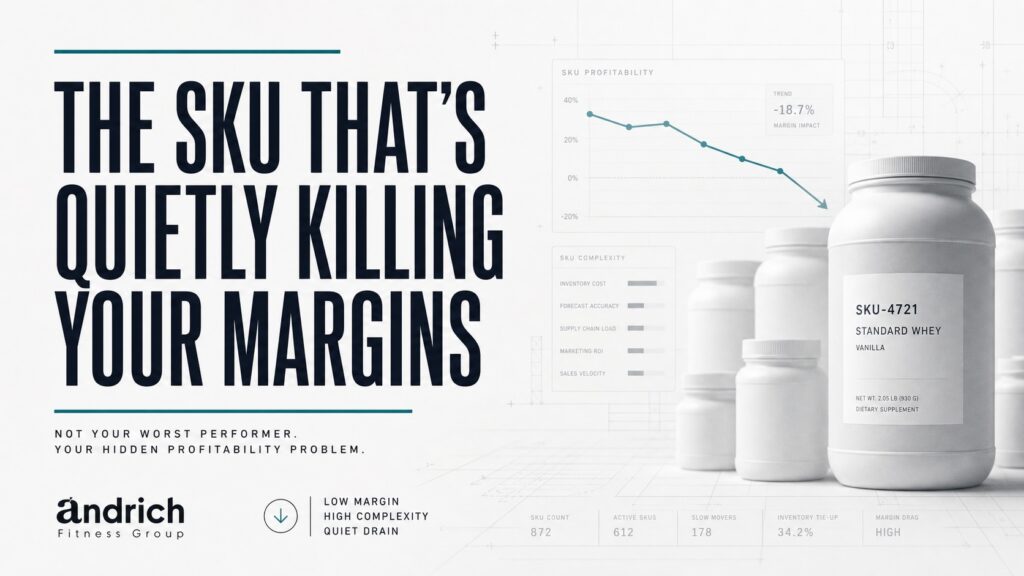
There’s a product in your lineup right now that looks fine on paper.
It’s not a disaster. It moves. It doesn’t generate complaints. When someone asks how it’s doing, you say “okay” — and you move on to the next conversation.
That SKU is probably your biggest margin problem.
Not your worst performer. Not the obvious failure you already know about. The one that’s okay. The one that gets just enough resources to survive but not enough focus to win. The one that’s quietly absorbing production runs, shelf space, marketing budget, and sales team attention — while your real hero SKU sits underleveraged.
I’ve seen this pattern destroy the profitability of brands that had every right to win. And I’ve seen it happen slowly enough that nobody notices until the P&L tells a story nobody can explain.
Why “Okay” Is the Most Dangerous Word in Your Portfolio
When a SKU fails outright, you cut it. The decision is uncomfortable but clear.
When a SKU succeeds, you invest. Also clear.
The problem is everything in the middle. The SKUs that are doing okay create a false sense of security and an invisible drain on the business.
Here’s what “okay” usually means when you look underneath it:
Gross margin is below category average but not low enough to trigger a review.
Velocity is flat but distribution is holding, so it doesn’t show up as a problem.
It only moves on deal. Promo dependence is hiding a structural pricing problem.
It’s competing with your own hero SKU for the same buyer, cannibalizing instead of expanding.
Repeat purchase rate is low but new-to-file numbers mask it.
None of these show up on a top-line revenue report. They only surface when you do the actual work of disaggregating the data, channel by channel, margin by margin, buyer cohort by buyer cohort.
Most brands never do that work. They’re too busy launching the next product.
The Portfolio Math Nobody Does
Here’s a scenario I’ve seen play out at brands across every revenue range from $5M to $100M.
A brand has six SKUs. Two of them drive 70% of revenue and nearly all of the gross margin. Two more are early-stage and absorbing investment. The fifth is legacy — it’s been around since the beginning and the founder has emotional attachment to it. The sixth is the newest launch, full of optimism and underfunded support.
The two hero SKUs are working. But instead of concentrating resources on them — better retail placement, more marketing support, a line extension into an adjacent format — those resources are spread across six products with six different stories, six different buyer profiles, and six different sets of channel requirements.
The result: the heroes underperform what they could do, the okay SKUs survive without earning it, and the business plateaus at a revenue level that feels like growth but is actually just complexity.
The fix isn’t launching a seventh product. It’s doing the math you’ve been avoiding.
The Scorecard That Actually Reveals the Problem
When I run a SKU rationalization audit, I’m looking at eight metrics across every product in the lineup.
Net revenue and unit volume — the baseline. What is this SKU actually contributing?
Gross margin by channel — not blended. Channel-level margin tells you whether DTC, retail, and Amazon are each profitable or if one route is subsidizing the others.
Velocity per store or per listing — this is the real demand signal. A SKU with wide distribution and low velocity is a problem hiding behind geography.
Repeat purchase rate — the clearest signal of product-market fit. If first-time buyers aren’t coming back, the product isn’t delivering on its promise.
New-to-file percentage — which SKUs are recruiting new customers versus selling only to people who already know you?
Promo dependence — if a SKU only moves when it’s on deal, that’s a structural problem, not a temporary one.
Cannibalization risk — is this SKU growing the business or just moving buyers from one of your products to another?
Competitive position — can this SKU win in its current form, or is it playing defense in a fight it’s going to lose?
When you look at a portfolio through these eight lenses simultaneously, the “okay” SKUs stop looking okay very quickly.
The Five Decisions Every SKU Gets
At the end of the audit, every product lands in one of five buckets. No gray areas.
Keep — strong fundamentals across all dimensions. Protect it, maintain it, don’t over-engineer it.
Invest — clear upside with the right commercial support. This is your growth SKU. Get behind it.
Fix — underperforming but salvageable. Specific repositioning, channel changes, or pricing adjustments can unlock real value.
Harvest — past its growth window. Minimize support, extract remaining margin, and prepare for an exit.
Exit — structurally unprofitable or strategically misaligned. Discontinue and reallocate the resources.
The hardest decision is always the Fix category — because it requires an honest assessment of whether the problem is fixable and whether you have the bandwidth to fix it. Most brands default to keeping Fix SKUs alive indefinitely, which is how “okay” becomes a long-term drag on the business.
What Happens When You Get This Right
When brands do this work — really do it, with actual data instead of intuition — two things happen consistently.
First, they find margin they didn’t know they had. Exiting one or two structural losers can shift the blended gross margin by three to five points without changing a single formula or renegotiating a single vendor contract.
Second, they find growth they were leaving on the table. The hero SKU that was getting 40% of the attention it deserved suddenly gets 80%. That concentrated investment compounds — better retail placement, more marketing efficiency, faster repeat purchase rates.
The portfolio math is simple. The hard part is being honest enough to do it.
If your portfolio has a SKU that’s doing okay — and most do — it’s worth finding out what that word is actually costing you.
The Product Portfolio Audit is a focused, operator-level analysis of your entire lineup. Every SKU scored. Every decision clarified. Delivered in two weeks with a readout call so you know exactly what to do next.
Book a free discovery call to scope your engagement: https://meetings-na2.hubspot.com/vince-andrich
Learn more about the Product Portfolio Audit: https://andrichfitness.com/sku-audit/sku-audit-final.html
Vince Andrich is a commercial operator and brand strategist with 25+ years inside the growth engines of Quest Nutrition, Bang Energy, and JYM Supplement Science. He works directly with founders and CEOs of $5M–$100M health and performance brands.
There’s a product in your lineup right now that looks fine on paper.
It’s not a disaster. It moves. It doesn’t generate complaints. When someone asks how it’s doing, you say “okay” — and you move on to the next conversation.
That SKU is probably your biggest margin problem.
Not your worst performer. Not the obvious failure you already know about. The one that’s okay. The one that gets just enough resources to survive but not enough focus to win. The one that’s quietly absorbing production runs, shelf space, marketing budget, and sales team attention — while your real hero SKU sits underleveraged.
I’ve seen this pattern destroy the profitability of brands that had every right to win. And I’ve seen it happen slowly enough that nobody notices until the P&L tells a story nobody can explain.
Why “Okay” Is the Most Dangerous Word in Your Portfolio
When a SKU fails outright, you cut it. The decision is uncomfortable but clear.
When a SKU succeeds, you invest. Also clear.
The problem is everything in the middle. The SKUs that are doing okay create a false sense of security and an invisible drain on the business.
Here’s what “okay” usually means when you look underneath it:
Gross margin is below category average but not low enough to trigger a review.
Velocity is flat but distribution is holding, so it doesn’t show up as a problem.
It only moves on deal. Promo dependence is hiding a structural pricing problem.
It’s competing with your own hero SKU for the same buyer, cannibalizing instead of expanding.
Repeat purchase rate is low but new-to-file numbers mask it.
None of these show up on a top-line revenue report. They only surface when you do the actual work of disaggregating the data, channel by channel, margin by margin, buyer cohort by buyer cohort.
Most brands never do that work. They’re too busy launching the next product.
The Portfolio Math Nobody Does
Here’s a scenario I’ve seen play out at brands across every revenue range from $5M to $100M.
A brand has six SKUs. Two of them drive 70% of revenue and nearly all of the gross margin. Two more are early-stage and absorbing investment. The fifth is legacy — it’s been around since the beginning and the founder has emotional attachment to it. The sixth is the newest launch, full of optimism and underfunded support.
The two hero SKUs are working. But instead of concentrating resources on them — better retail placement, more marketing support, a line extension into an adjacent format — those resources are spread across six products with six different stories, six different buyer profiles, and six different sets of channel requirements.
The result: the heroes underperform what they could do, the okay SKUs survive without earning it, and the business plateaus at a revenue level that feels like growth but is actually just complexity.
The fix isn’t launching a seventh product. It’s doing the math you’ve been avoiding.
The Scorecard That Actually Reveals the Problem
When I run a SKU rationalization audit, I’m looking at eight metrics across every product in the lineup.
Net revenue and unit volume — the baseline. What is this SKU actually contributing?
Gross margin by channel — not blended. Channel-level margin tells you whether DTC, retail, and Amazon are each profitable or if one route is subsidizing the others.
Velocity per store or per listing — this is the real demand signal. A SKU with wide distribution and low velocity is a problem hiding behind geography.
Repeat purchase rate — the clearest signal of product-market fit. If first-time buyers aren’t coming back, the product isn’t delivering on its promise.
New-to-file percentage — which SKUs are recruiting new customers versus selling only to people who already know you?
Promo dependence — if a SKU only moves when it’s on deal, that’s a structural problem, not a temporary one.
Cannibalization risk — is this SKU growing the business or just moving buyers from one of your products to another?
Competitive position — can this SKU win in its current form, or is it playing defense in a fight it’s going to lose?
When you look at a portfolio through these eight lenses simultaneously, the “okay” SKUs stop looking okay very quickly.
The Five Decisions Every SKU Gets
At the end of the audit, every product lands in one of five buckets. No gray areas.
Keep — strong fundamentals across all dimensions. Protect it, maintain it, don’t over-engineer it.
Invest — clear upside with the right commercial support. This is your growth SKU. Get behind it.
Fix — underperforming but salvageable. Specific repositioning, channel changes, or pricing adjustments can unlock real value.
Harvest — past its growth window. Minimize support, extract remaining margin, and prepare for an exit.
Exit — structurally unprofitable or strategically misaligned. Discontinue and reallocate the resources.
The hardest decision is always the Fix category — because it requires an honest assessment of whether the problem is fixable and whether you have the bandwidth to fix it. Most brands default to keeping Fix SKUs alive indefinitely, which is how “okay” becomes a long-term drag on the business.
What Happens When You Get This Right
When brands do this work — really do it, with actual data instead of intuition — two things happen consistently.
First, they find margin they didn’t know they had. Exiting one or two structural losers can shift the blended gross margin by three to five points without changing a single formula or renegotiating a single vendor contract.
Second, they find growth they were leaving on the table. The hero SKU that was getting 40% of the attention it deserved suddenly gets 80%. That concentrated investment compounds — better retail placement, more marketing efficiency, faster repeat purchase rates.
The portfolio math is simple. The hard part is being honest enough to do it.
If your portfolio has a SKU that’s doing okay — and most do — it’s worth finding out what that word is actually costing you.
The Product Portfolio Audit is a focused, operator-level analysis of your entire lineup. Every SKU scored. Every decision clarified. Delivered in two weeks with a readout call so you know exactly what to do next.
Book a free discovery call to scope your engagement: https://meetings-na2.hubspot.com/vince-andrich
Learn more about the Product Portfolio Audit: https://andrichfitness.com/sku-audit/sku-audit-final.html
Vince Andrich is a commercial operator and brand strategist with 25+ years inside the growth engines of Quest Nutrition, Bang Energy, and JYM Supplement Science. He works directly with founders and CEOs of $5M–$100M health and performance brands.
