There’s a reason the most sophisticated health and performance brands keep coming back to podcast advertising. It’s not the reach. It’s the credibility transfer that happens when the right person says your name.
Vince Andrich | Founder, Andrich Fitness Group | June 2026
Key Statistics
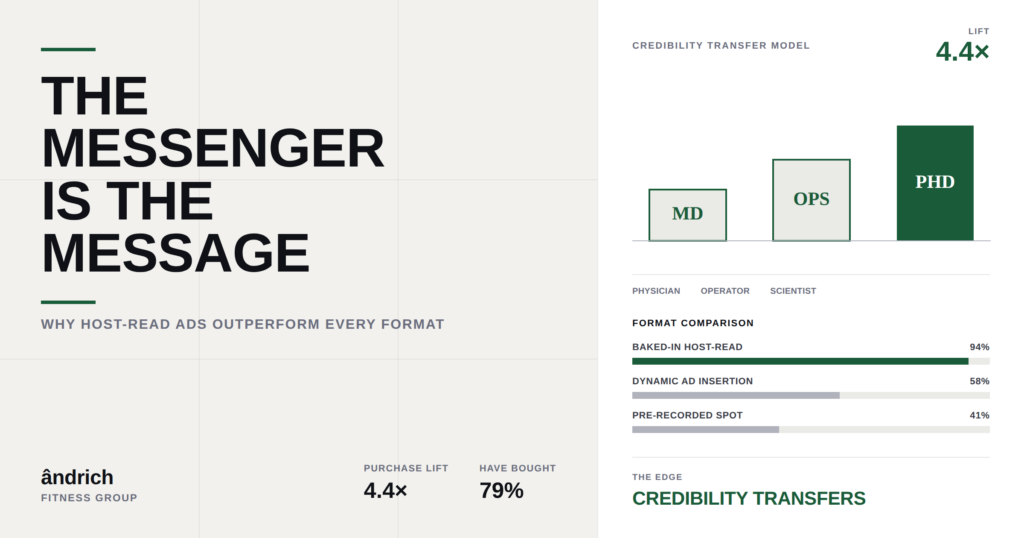
4.4× higher purchase intent from host-read ads vs. pre-recorded spots
88% of weekly podcast listeners say ads are a fair price for free content
79% of podcast listeners have made a purchase based on a host recommendation
The Mechanism
What actually happens when a host reads your ad
Most media formats separate the messenger from the message. A banner ad appears on a website someone is reading but has nothing to do with. A pre-roll plays before content a viewer didn’t choose. A social post appears in a feed between content from people the user actually follows.
Host-read podcast advertising is structurally different. The host is the content. Their audience chose to spend an hour with them specifically — not with the subject matter, not with a topic, but with that person’s voice, mind, and perspective. The trust relationship was built over months or years before your brand was ever mentioned.
When that host then tells their audience they use your product — personally, in their own voice, integrated into a conversation the listener is fully engaged with — something happens that no other media format can replicate: their credibility transfers to your brand.
The Credential Factor
In health and performance, who says it matters as much as what is said
The health and nutrition category has a credibility problem. Consumers have been oversold on supplements their whole lives. They’ve seen influencers promote products they clearly don’t use. They’ve read claims that don’t match reality. They’ve been burned.
The result: the health and performance buyer is one of the most skeptical consumers in any category. They read ingredient labels. They research studies. They look for third-party certifications. They trust credentials.
This is why the nature of the host matters enormously in this category — and why the right podcast placement produces results that no social campaign can replicate.
The Physician
A medical doctor recommending a protein product to their audience isn’t an ad read. It’s a clinical endorsement from someone with decades of training. The audience processes it that way.
The Operator
A decorated military veteran vouching for a performance supplement carries the weight of someone who has tested their body under conditions most listeners can only imagine. The trust is absolute.
The Scientist
A researcher whose work appears in peer-reviewed journals recommending a metabolic product is the closest thing to a clinical trial result that a brand can put in front of a consumer.
None of these credentials exist in social media influencer marketing. An influencer’s authority is aspirational. A podcast host’s authority is earned through demonstrated expertise over time.
The Format Advantage
Dynamic vs. baked-in: why permanence compounds
There are two ways to run a podcast ad. Dynamic Ad Insertion (DAI) places a pre-recorded spot that can be swapped out over time — useful for reach and flexibility, but heard as an interruption, not an endorsement. Baked-in host-read ads are recorded by the host and embedded permanently in the episode.
A baked-in host-read ad is less like a paid placement and more like a permanent editorial endorsement. The host chose to record it. It lives in the episode forever. Every new listener who discovers that episode hears that recommendation.
— Vince Andrich, Andrich Fitness Group
The back catalog effect is real and systematically undervalued. When a listener discovers a show they love, they binge. They go back to episode one. They listen through years of content. A baked-in ad placed 18 months ago keeps reaching new listeners — listeners who weren’t even aware of the show at the time of placement.
The Implication
What this means for how you evaluate a placement
The standard media buying framework — reach, frequency, CPM — was built for formats where the messenger and the message are separate. It doesn’t capture what actually drives performance in host-read podcast advertising.
The Right Questions to Ask Before Placing
Does this host have genuine credibility with their audience in a domain adjacent to our product? Has that credibility been built over time through demonstrated expertise — not purchased through follower growth? Is the audience actively investing in their health and performance, or passively consuming content? Is there a category conflict — an incumbent brand that has already claimed this audience’s trust in our lane? Is the placement baked-in, or will it be dynamically swapped out before the back catalog compounds?
These questions don’t show up on a standard media plan. But they’re the difference between a podcast placement that moves product and one that generates impressions no one remembers.
Vince Andrich | Andrich Fitness Group | Vince@andrichfitness.com
