
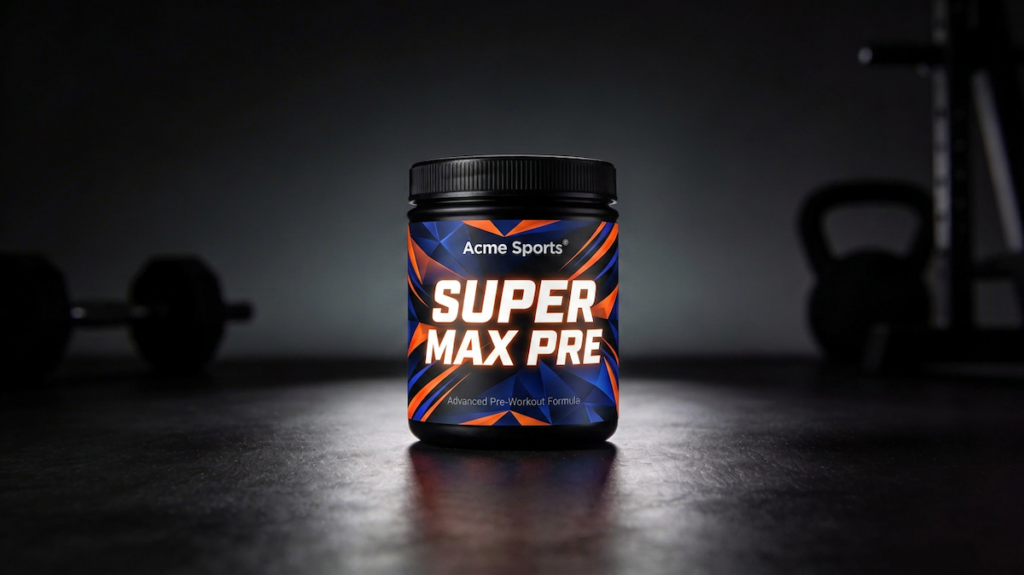
Here’s a scenario I see constantly in the sports nutrition category.
A brand launches a pre-workout with a genuinely strong formula. Clinical doses. Real ingredients. The kind of stack that advanced lifters actually recognize and respect. The product gets good reviews. Repeat buyers are happy. But conversion on the product page is soft and nobody can figure out why.
The formula isn’t the problem. The signal is.
The Diagnosis
When I look at a product page that’s underperforming, the first thing I’m looking for isn’t the ingredient panel — it’s the messaging hierarchy. Who is this product talking to? What’s the primary promise? And is that promise landing the same way for every visitor who hits the page?
In the case I want to walk through, the product is a clinical-dose pre-workout positioned as a step up from the brand’s entry-level formula. Strong pump ingredients, dual-phase caffeine, solid nootropic stack. Everything an experienced lifter wants to see.
The problem: the product page was trying to speak to two completely different buyers with one voice and doing it in the language that only one of them understood.
The Two Buyers
Every mid-tier pre-workout in this category has two distinct audiences, and most brands either ignore one of them or accidentally condescend to both. But knowing their demographics isn’t enough. To fix conversion, you need to understand their behavior — what triggers a purchase, what stops one, and where they buy.
| Persona Trait | Experienced Lifter (“Max”) | Aspiring Lifter (“Level-Up Leo”) |
| Purchase triggers | Runs out of pre, sees a new formula, compares stim ratings | Feels tired before workouts, wants “that pump” others have |
| Top objections | Under-dosed, proprietary blends, too much filler | Jitters, crash, chemical taste, waste of money |
| Where they buy | Direct site (reads labels), Reddit, review sites | Amazon, TikTok shop, GNC (needs social proof) |
| How they use your page | Scrolls straight to supplement facts, then price | Watches video, reads reviews, looks for “easy start” |
Buyer One: The Experienced Lifter
This person tracks macros, reads labels, and knows what 6g L-Citrulline means. They want clinical dose callouts. They respond to “300mg dual-phase caffeine” and “Alpha-GPC for focus.” They’re comparing your ingredient profile against competitors and they’re buying on specificity.
For this buyer, the message is straightforward: Max clinical dose. Max PR.
Buyer Two: The Aspiring Lifter
This person trains seriously and wants to train harder. They care about results — motivation, pumps, energy that doesn’t crash — but they don’t parse ingredient language the way an advanced lifter does. They’re not a beginner. They just think differently about what they’re buying.
Here’s the critical mistake most brands make with this buyer: they talk down to them. “New to pre-workout? Start here.” Nobody self-identifies as a beginner, especially in fitness culture. The framing has to be aspirational, not remedial.
For this buyer, the message isn’t about clinical doses — it’s about identity and outcome: More motivation. More muscle. Level up.
The Insight That Changes Everything
The temptation is to write two different taglines — one for each buyer — and rotate them or A/B test them against each other.
That’s the wrong move.
The right move is to anchor both buyers to a single master promise and then give each of them a path into that promise that speaks their language.
The master promise for this product: Advanced pre-workout performance, made usable every day.
Everything else ladders up to that. Clinical dosing, dual-phase energy, pump ingredients — these are proof points, not headlines. They support the promise; they don’t replace it.
Think of it like a high-end espresso machine. The advanced buyer wants barista specs, pressure bars, temperature control. The aspiring buyer wants “strong coffee, no bitterness, faster mornings.” Same machine, different entry points. Your product page should work the same way.
On page, this executes as a unified hero with a split module below it:
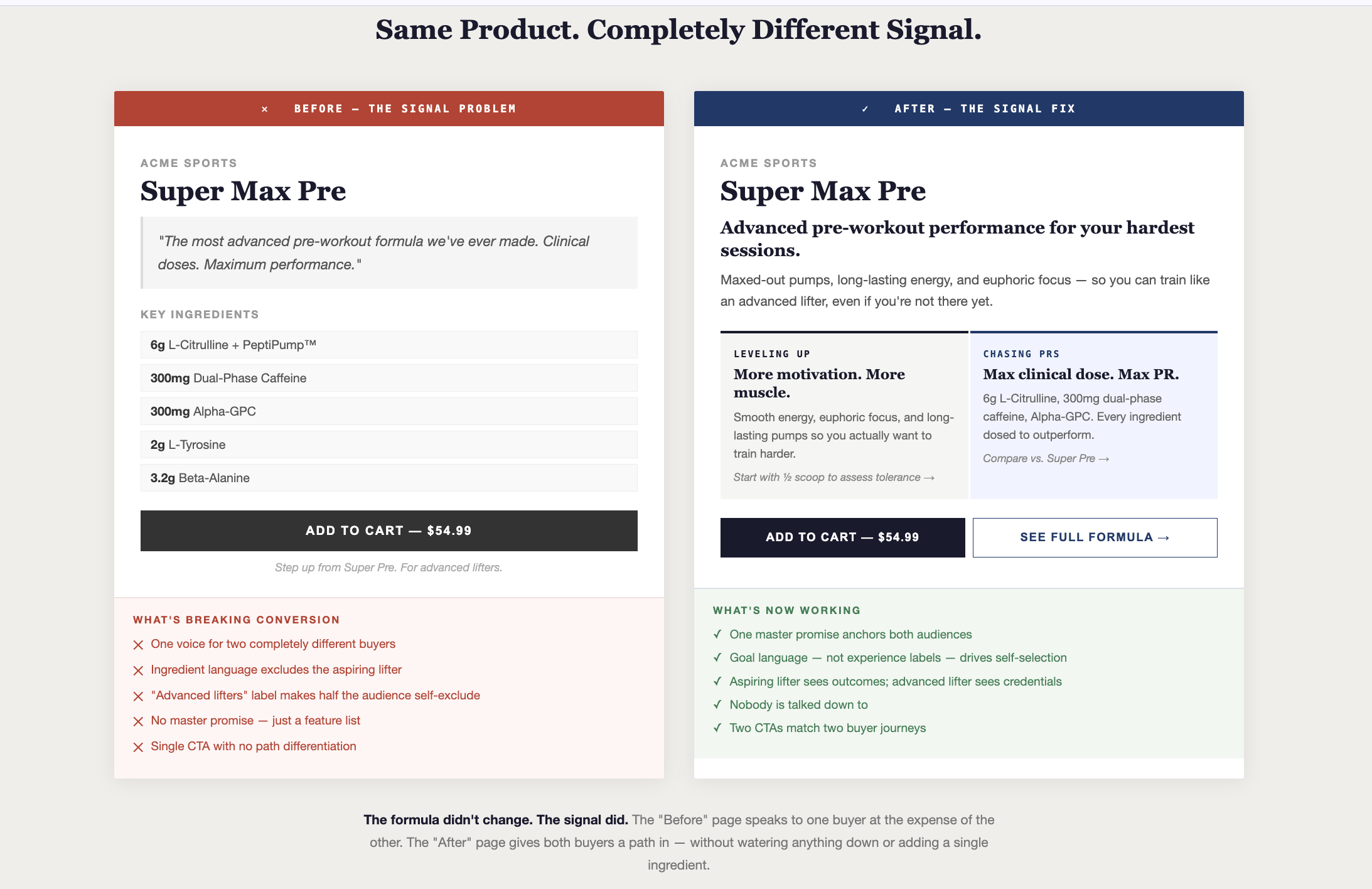
Hero headline: “Advanced pre-workout performance for your hardest sessions.”
Supporting line: “Maxed-out pumps, long-lasting energy, and euphoric focus — so you can train like an advanced lifter, even if you’re not there yet.”
Then two paths, framed by goal — not by experience level:
- Chasing PRs? → Max clinical-dose performance. 6g L-Citrulline, 300mg dual-phase caffeine, Alpha-GPC.
- Leveling up? → More motivation, more muscle, smooth energy without the crash. Start with ½ scoop.
Notice what’s not there: “Beginner,” “New to pre-workout,” “Getting started.” Those phrases kill conversion because they ask the buyer to self-identify as someone who isn’t advanced. Nobody clicks that.
What This Looks Like in Practice (Above the Fold):
- Hero headline + supporting line (see example below right)
- Two large, equal buttons: “Chasing PRs →” / “Leveling Up →”
- Clicking “Chasing PRs” scrolls to a clinical dose panel with ingredient callouts, third-party testing badge, and batch traceability.
- Clicking “Leveling Up” scrolls to a benefit-focused panel: “More energy, less crash. Start with ½ scoop. No label-decoding required.” Plus real before/after user photos and a clear return policy.
- Don’t forget: trust signals are persona-specific.
- The Experienced Lifter needs to see: third-party testing badge, “no proprietary blends” disclosure, batch traceability.
- The Aspiring Lifter needs to see: real before/after user photos (not models), “works for normal people” testimonials, a 30-day return policy.
- Even with perfect messaging, if you lack persona-specific trust signals, you still leak conversions.
Why This Works
The bifurcated module isn’t two different products. It’s one product with two entry points into the same outcome.
The experienced lifter reads the clinical callouts and buys on credentials. The aspiring lifter reads the benefit language and buys on outcome. Neither feels like they’re being talked down to. Neither is confused about whether this product is for them.
This is the difference between a product page that converts and one that leaks.
But what about decision paralysis? Adding two clear paths can sometimes cause hesitation (Hick’s Law). The fix is simple: add a default recommendation. Underneath the “Leveling Up” path, include a subtle line: “Most people start here →” This guides without condescending and turns a binary choice into a gentle nudge.
The Bigger Principle
Every underperforming product page I’ve seen in this category has a version of this problem. The formula is strong but the message is either too technical for half the audience or too vague for the other half.
The fix is never to simplify the formula. It’s to build a messaging architecture that lets different buyers find their own reason to buy — without the brand having to water anything down.
Good positioning doesn’t pick a lane and abandon everyone else. It finds the master promise that’s true for every buyer, then gives each buyer the language that makes that promise feel personal.
That’s the work. And it’s almost always worth more than the next product launch.
Vince Andrich is a commercial operator and brand strategist with 25+ years inside the growth engines of Quest Nutrition, Bang Energy, and JYM Supplement Science. He works directly with founders and CEOs of $5M–$100M health and performance brands through two focused engagements: the Product Portfolio Audit and the Positioning & Messaging System.
